
STEP is not a standalone funding programme. STEP pools resources from 11 EU funding programmes to support investment in strategic technologies and in people who can implement/manage those technologies.
Support can also come from more than one EU funding programme. For instance, grants under the Innovation Fund could be combined with grants under cohesion funds. Facilitating such cumulative funding is one of the purposes of the STEP Seal.
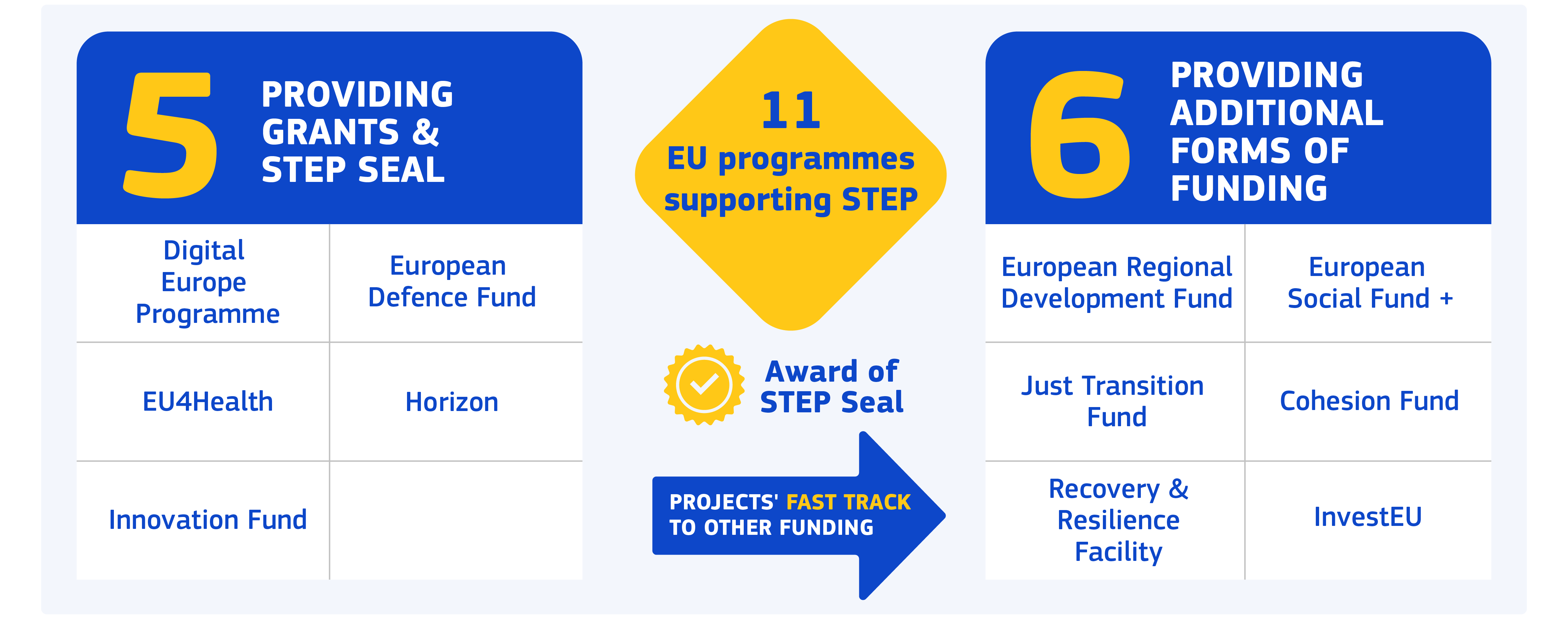
Funding at EU level: grants, equity and STEP Seal
The European Commission (including its executive agencies) directly manages the following programmes supporting STEP objectives: the Digital Europe programme, the European Defence Fund (benefiting from a reinforcement of €1.5 in the STEP priority areas), the EU4Health programme, Horizon Europe, and the Innovation Fund.
- These resources are often awarded as grants (i.e., they do not come with a repayment obligation) but could also take the form of equity facility (e.g. EIC under Horizon Europe). To receive such grants, you need to apply to the relevant calls for proposals at EU level. You can find them listed in the section Get funding.
- The evaluation of submitted proposals, the signing of the grant agreement, the monitoring of project implementation, the assessment of the results and the actual payments are carried out by the Commission including EU executive agencies.
- In addition, the European Commission awards a label of excellence to promising projects. The main goal of the STEP Seal is to help obtain alternative or additional funding from public and private sources beyond the EU programme under which the Seal was awarded. In addition to promotion on the STEP porta, the STEP Seals projects benefit from enhanced visibility toward investors on dedicated platforms such as Dealflow and the InvestEU Portal.
Horizon Europe
Pillar II - GLOBAL CHALLENGES & EUROPEAN INDUSTRIAL COMPETITIVENESS
Cluster 4: Digital, Industry and Space
Objective: Reinforce European independent capacity to access space, securing the autonomy of supply for critical technologies and equipment, and fostering the EU's space sector competitiveness.
Total budget 2023-2024: EUR 494 million
STEP sectors:
- Digital tech & deep tech innovation
- Clean & resource efficient tech
Example of actions: Collaborative space research and innovation projects, in-orbit demonstration and validation, boosting entrepreneurship of space companies, etc.
| What is it for? |
|
|---|---|
| Who can apply? |
|
| What does it offer? |
|
Pillar III - INNOVATIVE EUROPE
European Innovation Council
Objective: Supporting game changing innovations throughout the lifecycle with an emphasis on EU industrial leadership and the green and digital transitions. The EIC offers initial funding to fast-growing start-ups, small mid-caps, and companies seeking capital for scaling up beyond the initial innovation stage.
Total budget 2021-2027: EUR 10.1 billion
STEP sectors:
- Digital tech & deep tech innovation
- Clean & resource efficient tech
- Biotech
- Defence tech (under EIC Scale Up call only)
Example of actions: Research, innovation, pilot actions, market deployment actions, networking and coordination, training and mobility actions, dissemination and exploitation of results, etc.
Advisory services: Business Acceleration Services
| EIC Pathfinder | |
|---|---|
| What is it for? |
|
| Who can apply? |
|
| What does it offer? |
|
| EIC Transition | |
|---|---|
| What is it for? |
|
| Who can apply? |
|
| What does it offer? |
|
| EIC Accelerator | |
|---|---|
| What is it for? |
|
| Who can apply? |
Note: EIC Accelerator follows a multi-step application procedure which begins with a short application and a pitch video, is followed by an application form and, if successful, leads to an interview invitation to a face-to-face pitch week in Brussels. |
| What does it offer? |
|
Digital Europe Programme
Objective: Driving the EU’s digital transition
Total budget 2021-2027: Over EUR 8 billion
STEP sector: Digital tech & deep tech innovation
Example of actions: Acquisition of exa-scale machines related to high-performance computing, set-up of data spaces and testing and experimentation facilities for artificial intelligence, setting-up of cybersecurity centres, deployment of a network of European digital innovation hubs, support for interoperability
| What is it for? |
|
|---|---|
| Who can apply? |
|
| What does it offer? |
|
EU4Health Programme
Objective: Improve and foster health, protect people, access to medicinal products, medical devices and crisis-relevant products, strengthen health systems
Total budget 2021-2027: EUR 4.6 billion
STEP sector: Biotech
Example of actions: Crisis preparedness, disease prevention, health systems and healthcare workforce and digitalisation.
| What is it for? |
|
|---|---|
| Who can apply? |
|
| What does it offer? |
|
European Defence Fund
Objective: Delivering the next generation defence systems
Total budget 2021-2027: EUR 7.3 billion including a top up of EUR 1.5 billion specifically for STEP actions
STEP sectors:
- Digital tech & deep tech innovation
- Clean & resource efficient tech
- Biotech
- Defence tech
Type of actions: Collaborative defence research projects; joint development of defence products and technologies.
| What is it for? |
|
|---|---|
| Who can apply? |
|
| What does it offer? |
|
Innovation Fund
Objective: Bringing to the market solutions to decarbonise the European industry
Total budget 2020-2030: around EUR 40 billion, funded by Emission trading system (ETS)
STEP sector: Clean & resource efficient tech
Type of actions: Flagship projects that can bring significant emission reductions
Advisory services: Project development assistance
| What is it for? |
|
|---|---|
| Who can apply? |
|
| What does it offer? |
|
Additional forms of EU funding implemented at national level
A large part of the EU budget is managed jointly by the European Commission and EU Member States.
The EU legal framework (STEP Regulation and Cohesion mid term review) encourages Member States to allocate part of their Cohesion policy funds including the Cohesion Fund, the European Regional Development Fund, the European Social Fund+ and the Just Transition Fund as well as the Recovery and Resilience Facility, to actions supporting STEP objectives. Often these resources are in the form of grants (i.e. non-repayable) but could also take the form of procurements or financial instruments (e.g. equity, loans, and guarantees).
Since EU countries manage these funds, they also manage the publication of information about available funding opportunities at national level.
- To get an overview of the STEP-relevant calls for proposals you can consult the section Get funding on the STEP Portal which will redirect you to the National single portals for more precise information on upcoming funding opportunities at national level, namely which regions are covered by funding calls, who can apply, the amount of funding allocated to a given call for proposals, and the relevant timelines.
- For the repayable forms of support (financial instruments) you should liaise with the local financial institutions. The exact financing conditions – the amount, duration, interest rates and fees – are determined by these financial institutions. To find the right contact points to financial intermediaries and/or implementing partners responsible for administering EU-backed financial instruments in your region please consult the Access to EU Finance portal
Specific rules applying to Cohesion policy funds
STEP offers financial incentives to direct cohesion policy funds towards investments in critical technologies.
Co-financing
STEP offers a 100% co-financing rate for STEP priorities during the entire 2021–2027 programming period
Pre-financing
- A one-time 30% pre-financing option for Programme Amendments submitted by 31 March 2025.
- An exceptional one-off pre-financing of 20% to those programme amendments submitted by 31 December 2025.
- If a programme reallocates ≥10% of total allocation to the new priorities (including STEP) or 7% for some special categories of programmes, by 31 December 2025, the whole programme unlocks for 2026: Additional one-off prefinancing equal to 1.5% of total ERDF/CF/JTF support; or 9.5% if the programme covers regions bordering Russia or Ukraine. Extensions in the final date for eligibility of expenditure to 2030. Earlier reallocations to STEP priorities already adopted or in the pipeline also count towards the 10% threshold (no additional action is required by the MS in this case).
Large enterprises
Support for productive investments in large enterprises is made possible for the first time in less developed and transition regions, as well as in more developed regions in Member States with a GDP per capita below the EU-27 average. With the Cohesion Policy Mid-term Review (MTR), the STEP incentives for large enterprises remain and are extended to other priorities such as IPCEIs, which may be relevant for STEP if in the STEP sectors.
Direct award
Direct award to projects with a STEP Seal is allowed under the European Regional Development Fund (ERDF) and the European Social Fund Plus (ESF+). With the Cohesion Policy MTR, direct support to STEP Seals and Important Projects of Common European Interest (IPCEI) are also introduced, including for the Just Transition Fund if in line with specific objectives and contributing to Just Transition Plans.
Specific rules applying to Recovery and Resilience Facility
Under the Recovery and Resilience Facility, Member States have the option to allocate up to 6% of their national envelope to STEP-relevant financial products under InvestEU.
Furthermore, when revising their recovery and resilience plans, Member States should consider supporting as priority those projects that have been awarded the STEP Seal
Key facts you need to know about STEP contributing programmes:
Cohesion Fund
Objective: Supporting Member States with a gross national income per capita below 90% of the EU27 average
Total budget 2021-2027: EUR 48.03 billion, including EUR 11.29 transferred to the Connecting Europe Facility
STEP sector: Clean & resource efficient tech
Type of actions: Modernisation and development of railway axis and junctions, modernisation water infrastructure, extension of public transport’s network...
| What is it for? |
|
|---|---|
| Who can apply? |
|
| What does it offer? |
|
European Social Fund+
Objective: Investing into people and building a more social and inclusive Europe
Total budget 2021-2027: EUR 142.7 billion
STEP sector:
- Digital tech & deep tech innovation
- Clean & resource efficient tech
- Biotech
- Defence tech
Type of actions: Projects in the field of employment, education & skills, and social inclusion
| What is it for? | Support projects on:
|
|---|---|
| Who can apply? |
|
| What does it offer? |
|
European Regional Development Fund
Objective: Strengthening economic, social and territorial cohesion
Total budget 2021-2027: EUR 226.05 billion
STEP sector:
- Digital tech & deep tech innovation
- Clean & resource efficient tech
- Biotech
- Defence tech
Type of actions:
Make Europe and its regions:
- More competitive and smarter
- Greener
- More connected
- More social
- Closer to citizens
| What is it for? |
|
|---|---|
| Who can apply? |
|
| What does it offer? |
|
Just Transition Fund
Objective: Supporting the reconversion of territories expected to be the most negatively impacted by the transition towards climate-neutrality
Total budget 2021-2027: EUR 19.32 billion
STEP sector:
- Clean & resource efficient tech
- Defence tech
Type of actions:
Support can be provided to:
- Up- and reskilling of workers
- Productive investments in SMEs
- Creation of new firms
- Environmental rehabilitation
- Investment in clean energy
- Job-search assistance
- Transformation of existing carbon-intensive installations
| What is it for? |
|
|---|---|
| Who can apply? |
|
| What does it offer? |
|
Recovery and Resilience Facility
Objective: To mitigate the economic and social impact of the Covid-19 pandemic and make Member States’ economies and societies more sustainable, resilient and prepared for the green and digital transitions
Total budget 2021-2026: The RRF will disburse up to EUR 648 billion (this figure corresponds to what Member States requested under the national Recovery and Resilience Plans by end 2023)
STEP sectors:
- Digital tech & deep tech innovation
- Clean & resource efficient tech
- Biotech
- Defence tech
Type of actions: Reforms and investments that are in line with the 11 assessment criteria of the RRF Regulation (incl. two additional criteria for measures in the REPowerEU chapter), notably addressing the challenges identified in country-specific recommendations under the European Semester framework and EU priorities such as the green and digital transitions. The Recovery and Resilience Scoreboard gives an overview of how the implementation of the Recovery and Resilience Facility (RRF) and the national recovery and resilience plans is progressing. A guidance explains the process for modifying the Recovery and Resilience Plans, including the allocation of resources towards STEP objectives.
| What is it for? | Projects across 6 policy pillars:
|
|---|---|
| Who are the targeted stakeholders? |
|
| What does it offer? |
|
Mid-Term Cohesion Review benefits
The Mid-Term Review (MTR) of Cohesion Policy adopted on the 19 September 2025 modifies the European Regional Development Fund (ERDF), the Cohesion Fund (CF), the Just Transition Fund (JTF) and the European Social Fund + (ESF+) Regulations to further promote investments in defence and competitiveness, including by large enterprises. It offers a set of incentives to encourage Member States to carry out a meaningful reprogramming towards several priorities, including defence under STEP.
Concretely, STEP maintains its 100% co-financing incentive and the opening for large enterprises, extending these to IPCEIs. The MTR removes the previous 20% maximum allocation limit for STEP and extends higher pre-financing possibilities for programmes including STEP priorities, granting a one-off pre-financing of 20% for submissions by 31/12/2025.
Moreover, if by 31/12/2025 a programme reallocates at least 10% of its total allocation (or 7% for certain categories) to new priorities including STEP, the entire programme unlocks for 2026 an additional one-off pre-financing of 1.5% of total ERDF/CF/JTF support (or 9.5% for programmes covering regions bordering RU/UA) and an extension of expenditure eligibility until 2030. Allocations that have been implemented before the MTR are counted toward the above-mentioned 10% threshold automatically, with no need for further Member State action. A more flexible approach regarding the requirement of thematic concentration is also introduced, with more flexible rules for STEP and defence investments.
Repayable forms of funding
These include equity, loans, and guarantees that can be used for various types of investments. These are implemented in collaboration with public and private institutions (e.g. banks and equity funds). Such repayable forms of funding are demand-driven and based on a market logic. Before awarding funding, the financial institution in charge examines projects that fall within their geographic and activity scope. It also decides on the specific financing conditions, including the amount, duration, interest rates and fees.
The repayable support under InvestEU programme is channelled through Implementing Partners i.e. the European Investment Bank Group and other international financial institutions and national promotional banks and institutions, and the network of local financial intermediaries acting across the European Union.
InvestEU financial products deployed by implementing partners are covering different types of repayable support from debt, guarantees to equity for a very broad set of EU policy areas, technology readiness levels and stages of innovation, including investment in manufacturing and deployment of STEPs technologies. Examples of financial products available goes from senior, subordinated and venture debt to intermediate and direct equity and guarantees to financial intermediaries.
The InvestEU Fund, part of the InvestEU programme, provides support to final recipients that are deemed economically and financially viable. All size of companies and projects, as well as a broad range of riskiness levels of operations, can be supported. The eligible final recipients can be natural or legal persons established in an EU country or in a third eligible country, including:
- Private entities such as special-purpose vehicles (SPV) or project companies, large corporates, midcap companies, including small midcap companies, start-ups and SMEs
- Public sector entities (territorial or not) and public-sector type entities
- Mixed entities, such as public–private partnership (PPPs) and private companies with a public purpose
- Non-for-profit organisations
How to apply for financing?
- Project promoters should apply directly to Implementing Partners to see on suitable financing solutions based on the financial products supported by the EU guarantee.
- Financial intermediaries should also consult the offering of implementing partners active in their regions proposing relevant products: it is up to them to select financial intermediaries through procedures such as calls for expressions of interest.
- Small mid-caps, SMEs, start-ups and social or micro-enterprises: should apply to their local commercial or public banks whose financial products are covered by the EU guarantee in their country or region. The local intermediary will inform them if a particular financing programme is covered by the InvestEU Fund.
Find your local intermediary on our Access to EU Finance website, which already lists intermediaries under current EU programmes and will successively list InvestEU financial intermediaries.
You can also wish to register to the InvestEU Portal that brings together investors and project promoters on a single EU-wide platform, by providing visibility and matchmaking opportunities for investment projects within the EU, Norway and Iceland. Project promoters can publish their project on the Portal to bring it to the attention of potential investors. Register your project and make it visible to an investor here.
For advisory support and technical assistance offered under InvestEU advisory hub you can apply through the Central Entry Point.
Key facts you need to know about STEP contributing programme
InvestEU Fund
Objective: Financing Europe’s future by supporting sustainable investment, innovation and job creation
Total budget 2021-2027: EUR 26.2 billion (i.e. size of the EU Guarantee made available to implementing partners)
STEP sectors:
- Digital tech & deep tech innovation
- Clean & resource efficient tech
- Biotech
Type of actions: Investment in economically viable projects in areas where there are market failures or investment gaps
Advisory services: InvestEU Advisory Hub
| What is it for? | Leverage private and public funds in support of Europe’s sustainable recovery, by increasing the risk-bearing capacity of financial partners in 4 policy windows:
|
|---|---|
| Who can apply? | The InvestEU Fund, part of the InvestEU programme, provides support to final recipients that are deemed economically and financially viable. All size of companies and projects, as well as a broad range of riskiness levels of operations, can be supported. The eligible final recipients can be natural or legal persons established in an EU country or in a third eligible country, including:
The applying process depends on who you are and what you are looking for:
Find your local InvestEU Implementing Partner on our Access to EU Finance website. For advisory support and technical assistance offered under InvestEU Advisory Hub you can apply through the Central Entry Point. Check EIB Group fast-track system for start-ups and scale-ups to seek financing under TechEU Programme.New TechEU Platform ensures swift responses to financing proposals and features “Investment Readiness Checker”. |
| What does it offer? |
|

